

 Français
 Deutsch
 한국어
한국어
PCB13, Polarizing Cube Beamsplitters, 5/10/12/12.5/15/20/25/50mm, SWIR Coating 900-1300nm, H-ZF3 Optical Glass
$395.83 – $1,875.00
Polarizing Cube Beamsplitters
Compared with the plate beamsplitters, the optical path length of the reflection and transmission light of the cube beamsplitters are equal, and there is no trouble with beam translation, ghost images, and interference.
Due to the split coating being all dielectric, there is no problem of light energy absorption.


Polarizing Cube Beamsplitters are usually used in applications where S-polarized light and P-polarized light in incident light need to be separated, and they can also be used as polarization components.
The P-polarized light of the incident light is completely transmitted, and the S-polarized light of the incident light is reflected in a vertical direction of 90°.
The level of separation of S light and P light is defined by the extinction ratio TP/TS.
Technical Specifications
| 1 | 2 |
|---|---|
| Material | H-ZF3 |
| Surface Quality | 40-20 |
| Transmission Beam Deviation | ±5 arcmin |
| Dimensions Tolerance | ±0.2mm |
| Coating-Hypotenuse | Beam Splitting Coating |
| Reflectivity | RS>99.5% |
| Induced Damage Threshold | >500mJ/cm², 20ns, 20Hz, @1064nm |
| 1 | 2 |
|---|---|
| Surface Accuracy | λ/ 10 @ 633 nm |
| Clear Aperture | 90% |
| Reflection Beam Deviation | 90°±5” |
| Bevel | Protective Bevel |
| Coating-Right Angle Surface | BBAR Coating |
| Transmittance | TP >90% |
| Extinction Ratio | TP/TS >1000 |

Polarizing Cube Beamsplitters 420-860nm
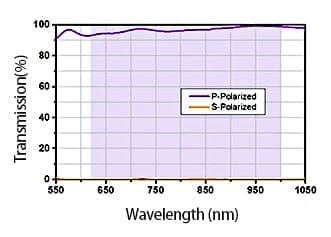
Polarizing Cube Beamsplitters 620-1000nm

Polarizing Cube Beamsplitters 900-1300nm
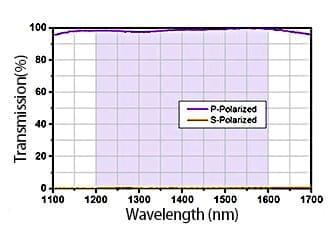
Polarizing Cube Beamsplitters 1200-1600nm
Kindly Reminder
It should be noted that because this kind of split coating itself has an element of polarization effect, the transmitted beam is partially polarized.
If you want to avoid the influence of polarization sensitivity, it is recommended to use our XXX- polarization splitting prism, or XXX- depolarization splitting prism.
| Weight | N/A |
|---|---|
| Size | 5mm, 10mm, 12.5mm, 15mm, 20mm, 25mm, 50mm |

Reviews
There are no reviews yet.